Dear Readers,
Apparently the text of An Aesthete's Lament is experiencing garbled wording here and there. I have called upon our crackerjack engineers to determine the problem and eradicate it. Your patience is much appreciated.
Sincerely,
The Aesthete
05 September 2011


04 September 2011
Home Away From Home
India is a country that looms large in my mind. Its culture,
its cuisine, its messy, glorious, violent history; the mindboggling decadence of its princely rulers; the abjectness of its impoverished; the rigidity of its
caste system; its flamboyant deities: All these things, for some reason, rivet
me no end. One cannot be bored by India; one can only be astounded.
Recently news that one of my favorite books, William Dalrymple’s riveting White Mughals, will be made into a movie—as well as the discovery of Penelope Treadwell's Johann Zoffany: Artist and Adventurer (Paul Holberton Publishing), a 2010 study of the 18th-century painter, who spent some artistic quality time in the court of Oudh—got me thinking about Indian style, especially those fertile moments in design, when subcontinental motifs and foreign influences collide and coalesce. (NB: How
the producers intend to shrink Dalrymple's sprawling tale of history, romance, and social anthropology into
a two-hour tale is beyond my comprehension; it really should be a miniseries
along the lines of "The Jewel in the Crown.")
 |
| A self-portrait of artist and designer Robert Home (1752-1834), court painter to the King of Oudh. This image, posted in Wikipedia's Robert Home article, has been in the collection of the National Portrait Gallery since 1943. |
This melding of styles is
not always an easy one but it is always entertaining and frequently inspiring. Take, for instance, the inexplicably underexamined work of
Robert Home (1752-1834), an intrepid Yorkshire expat who studied with German-born British painter
Angelica Kauffmann and ultimately found fame and fortune on the Indian
subcontinent, where he relocated around 1790. One sitter, in fact, described him as “the best artist in Asia.”
A native of the city of Hull, Home (pronounced "Hume") spent a highly productive chunk of his senior years in Lucknow, working for 13 years as the court painter to Ghazi-ud-din Haider (1769-1827), the seventh nawab wazir and first king of Oudh, before dying in Cawnpore. (The name of the kingdom is pronounced "uh-VUD.") This sophisticated monarch of Persian lineage and Muslim faith was limned by Home in a marvelous portrait that was identified last year. The circa-1819 image shown below was included in a 2011 exhibition of Lucknow portraiture at the Musée Guimet in Paris and is now offered for sale by the London gallery Philip Mould. Another of Home's portraits of his royal patron, a rather large example, is the collection of Queen Elizabeth II (Her Majesty also owns two additional Home works); another hangs in the Victoria Memorial Hall in Kolkata. A description of the last-cited painting, published in 1907, is as follows: "[The King] is dressed in a canary-yellow chapkan; and strings of pearls and other precious stones encircle his neck and bluish-yellow turban." When he wasn't busy painting the ruler, his wives, and their children, Home put likenesses of British official to canvas, including the Marquess of Wellesley (the future Duke of Wellington), of whom he painted more than a dozen portraits.
A native of the city of Hull, Home (pronounced "Hume") spent a highly productive chunk of his senior years in Lucknow, working for 13 years as the court painter to Ghazi-ud-din Haider (1769-1827), the seventh nawab wazir and first king of Oudh, before dying in Cawnpore. (The name of the kingdom is pronounced "uh-VUD.") This sophisticated monarch of Persian lineage and Muslim faith was limned by Home in a marvelous portrait that was identified last year. The circa-1819 image shown below was included in a 2011 exhibition of Lucknow portraiture at the Musée Guimet in Paris and is now offered for sale by the London gallery Philip Mould. Another of Home's portraits of his royal patron, a rather large example, is the collection of Queen Elizabeth II (Her Majesty also owns two additional Home works); another hangs in the Victoria Memorial Hall in Kolkata. A description of the last-cited painting, published in 1907, is as follows: "[The King] is dressed in a canary-yellow chapkan; and strings of pearls and other precious stones encircle his neck and bluish-yellow turban." When he wasn't busy painting the ruler, his wives, and their children, Home put likenesses of British official to canvas, including the Marquess of Wellesley (the future Duke of Wellington), of whom he painted more than a dozen portraits.
 |
| Ghazi-ud-din Haider, King of Oudh, circa 1819, in a portrait by Robert Hume. The work is presently being offered for sale by Philip Mould, a gallery in London. |
Home didn’t merely record august personages in brilliant oils. As an album of his
drawings held in the collection of the Victoria and Albert Museum bears
eyepopping witness, he also took up design with breathtaking abandon. Given the architecture, furniture, jewels, clothing, and decorative objects he proposed to the
monarch—how many of these fantasies were actually produced seems to be
unknown—one could easily call him the Thomas Hope of India. Like his English contemporary, Home seems to have been a master of
swaggering Regency extravagances flashy with gilding and not a little exotic
pomp. It is a pity that the Yorkshireman and the Prince Regent, later George IV, never met, because
the former’s objects for the British royal’s Oudhian counterpart would have
looked right at home in the delirious chinoiserie interiors of Brighton Pavilion.
 |
| An extraordinary crocodile barge designed for the King of Oudh by Robert Home. The image, which is contained in an album of Home designs held in the collection of the Victoria and Albert Museum, was published in "Made for Maharajahs: A Design Diary of Princely India" (Vendome Press, 2006). © V&A Images/ Victoria and Albert Museum. |
Whether driven by the otherworldliness
of the subcontinental kingdom where he resided or a natural sense of fantasy hybridized with fashionable British taste, Home was a man who trafficked in
extravagances. Among his works for Oudh's ruler (the seventh nawab wazir acceded to the throne in 1814, took the title of king in
1819, and reigned until his death in 1827) was a lengthy barge in the form of a grinning crocodile. On its scaly back sat a howdah-like
pavilion so the monarch of Oudh and one or more of his numerous wives—among them was an Anglo-Armenian and an Anglo-Indian—could relax in the shade as
rowers propelled them along the lazy waters of the Gombti River. Which, it must be added, was crossed by an iron bridge shipped from England on the King's orders.
 |
| The fish-shape Royal Boat of Oudh, a torpedo-like pleasure vessel with decorative fins, as seen circa 1858-1860. The image, by Anglo-Italian photographer Felice Beato (1832-1909), is from Bernard Shapero Fine Books, via Wikipedia's article about the photographer. |
Another royal Oudh boat in the same water-creature vein—which was recorded in a photograph snapped by Felice Beato in the middle of the 19th
century—assumes the shape of a fish, right down to its dorsal and tail fins.
A range of jalousied windows stretches along one side of the fish, and presumably the opposite as well, giving its
passengers a measure of privacy, which surely must have been welcomed given
the vessel’s bizarre appearance. The stately progress of this boat along the Gomti—a
giant, glistening fish skimming the waters like a god come to life—surely caused the jaws of the King’s subjects to drop. Whether it was designed by Home, however, is unknown. It seems a bit lumpen in its execution but the vessel's mad looks could well have been inspired by Home's work for the first King of Oudh. Or perhaps it was Home's work after all. Scholar Mildred Archer has written that the artist's proposals had a "certain zaniness," notably "silver carriages shaped like shells supported by peacocks and extraordinary boats in the form of a swan, fish or alligator." Perhaps this fish vessel is the very one described by a 19th-century eyewitness. He wrote of a fish-shaped pleasure boat "made of cedar, for the harem ladies, covered with scales of silver, each the size of a rupee though not so thick. The interior was more luxuriously fitted ... [and] there were jalousies through which the fair and dusky occupants, without being seen, could themselves look upon a city as naughty as Nineveh." One English resident of Lucknow in the 1850s recalled a royal boat shaped like a dolphin and brilliantly enameled.
 |
| An 1895 image of Bara Chattar Manzil, a palace complex erected by the first King of Oudh, which was built alongside the Gomti River between 1819 and 1837. Among its pleasures was an English-style picture gallery furnished with chairs designed by Robert Home. Image by G. W. Lawrie and Company, from the website Old Indian Photos. |
Capable of striking awe into the observer too was the enormous palace complex commissioned by the
king during Home’s tenure in Lucknow and in whose creation Home had a part. (The complex was such an ambitious project, however, that it was not completed until 1837, under the reign of the king's son and successor.) The picture gallery of the dome-topped Bara Chattar Manzil (Umbrella Palaces) was an essay in classical British taste and furnished with chairs made to Home's designs. The eminent British cleric Bishop Heber, who visited Lucknow for ten days in 1824—he declared it "the most polished and splendid court at present in India" and sat for his portrait by Home during his trip—left to posterity a detailed description of a formal breakfast in the room:
"... [It is] a long and handsome, but rather narrow, gallery, with good portraits of [the king's] father and [Governor-General of India] Lord Hastings over the two chimney-pieces, and some very splendid glass lustres hanging from the ceiling. The furniture was altogether English, and there was a long table in the middle of the room, set out with breakfast, and some fine French and English china. [The King] sate [sic] down in a gilt arm-chair in the center of one side, motioning to us to be seated on either hand. ... The King began by putting a large hot roll on the Resident's plate, and another on mine, then sent similar rolls to the young Nawâb his grandson, who sate on the other side of me, to the Prime Minister, and one or two others. Coffee, tea, butter, eggs, and fish were then carried round by the servants, and things proceeded much as at a public breakfast in England. The King had some mess of his own in a beautiful covered French cup, but the other Musselmans eat as the Europeans did."
Visitors to the palace during the reign of the King's son (his mother was a palace chambermaid) commented on the European-style atmosphere, ticking off a dining room "that differed from an English dining-room in no essential particular," a chef who hailed from France, and a coachman from Ireland. (The second King of Oudh, who openly declared his passion for anything European, also married an Englishwoman, the daughter of a rich Lucknow merchant.) It seems arguable that Home, with his expansive creativity, oversaw more than just the gallery's seat furnishings, though more research needs be conducted on this subject. (I plan on following this thread in the near future, hopefully with an update.)
The splendid palace complex, which is located on a bank of the Gomti River, caused some Western visitors to wince, particularly individuals claiming refined taste. The 1883 Encyclopaedia Britannica approached it with barely concealed condescension, calling the structure " a huge and irregular pile of buildings, crowned by gilt umbrellas, [that] glitters gaudily in the sunlight." An English visitor of the time had a similar opinion, reporting that it was "an immense mass of buildings with no architectural pretension." Partly transformed into a soldiers' club and library after the deposition of the royal family in the 1850s, Bara Chattar Manzil is now the headquarters of the Central Drug Research Institute.
 |
| Bara Chattar Manzil, the former palace of the King of Oudh, as it is today. Image from the website of the Central Drug Research Institute. |
The splendid palace complex, which is located on a bank of the Gomti River, caused some Western visitors to wince, particularly individuals claiming refined taste. The 1883 Encyclopaedia Britannica approached it with barely concealed condescension, calling the structure " a huge and irregular pile of buildings, crowned by gilt umbrellas, [that] glitters gaudily in the sunlight." An English visitor of the time had a similar opinion, reporting that it was "an immense mass of buildings with no architectural pretension." Partly transformed into a soldiers' club and library after the deposition of the royal family in the 1850s, Bara Chattar Manzil is now the headquarters of the Central Drug Research Institute.
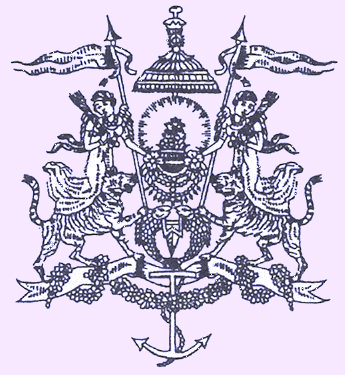 |
| The arms of the Kings of Oudh, which incorporate twin fishes centered between two tigers passant. The female figures appear to be winged mermaids, which also figured in Oudhian iconography. Image from the website Royal Ark. |
Twin fishes were emblazoned on the Oudh coat of
arms, so Home was careful to incorporate them into many of his designs. In his circa-1819 portrait of the king, however, Ghazi-ud-din Haider apparently sits in one of Home’s giltwood chairs, and no fishes are visible; instead, the scroll-arm chair seems to be ornamented with fruit-like finials. A fish-theme Oudh chair attributed to Home is in the collections of the Victoria and Albert Museum. Pictured below, it incorporates a double-fish backsplat and arms supported by scrolling elements that also possess a piscine silhouette. Given its stately yet madcap details, is it any reason I'm longing to see more of Home's creations, whatever they may be?
 |
| A carved-wood armchair with gilded brass and gilded gesso mounts, likely designed by Robert Home for the first king of Oudh, circa 1820. Later owned by the 5th Earl Amherst of Arracan, it is now in the collection of the Victoria and Albert Museum. © V&A Images/ Victoria and Albert Museum. The chair is also featured in the 2001 book "Furniture from British India and Ceylon" (Peabody Essex Museum in association with V&A Publications). |
02 September 2011
Fight Club
 |
| Angelica Kauffmann's 1787 portrait of Edward Smith-Stanley, 12th Earl of Derby, with his first wife, the former Lady Elizabeth Hamilton, and their heir, the future 13th Lord Derby. Don't let the happy scene fool you—the countess ended up running away with another nobleman, bearing an illegitimate daughter, and expiring at an early age. |
Over
the summer, members of The Friends of Honeywood Museum convened at the site of a
now-demolished 18th-century country house in Surrey, England, to discover evidence of an architectural curiosity: a cock-pit built for
Edward Smith-Stanley, 12th Earl of Derby, a Georgian Croesus whom historian Alistair
Rowan once described as “one of the Adam brothers’ most opulent patrons.”
While
steering well clear of animal-rights issues in this space, I do want to go
on record with my fascination with this project—and not only the archaeological dig, which unearthed nothing relating to the cock-pit, though its participants fished up antique brick foundations, the remains of 18th-century plaster architectural details, and a 1903 farthing. What impresses me most with The Oaks is Lord
Derby’s ingenious solution for fulfilling his at-home gaming desires. Designed as a mini-stadium for watching angry roosters maim each other in the name of sport, the earl’s
cock-pit was integrated into The Oaks, his dog's-breakfast of a country house.
 |
| The Oaks, as seen in an 1809 engraving. |
The building, which has been little studied, appears to have been a picturesque mishmash, set in the midst of a handsome park with gentle hills and painterly clumps of trees. Architectural historian Nikolaus Pevsner, for one, gingerly called The Oaks "large and irregular." (One suspects he really meant "ungainly and unfortunate" but couldn't bring himself to write the words.) Architect Robert Taylor designed its initial Palladian-villa phase in the 1750s and expanded that in 1765 for Lord Derby's paternal grandfather.
 |
| A view of the interiors of the temporary pavilion designed by Robert Adam in 1774 for The Oaks, Surrey. Lavishly plastered, richly statued, and comfortably furnished, the pavilion was built for a party celebrating the union of Edward Smith-Stanley, Lord Strange, heir to the 11th Earl of Derby, and Lady Elizabeth "Betty" Hamilton. |
In 1774, in order to celebrate his forthcoming wedding to a daughter of the 6th Duke of Hamilton, the young aristocrat commissioned Robert Adam to erect a grandiose pavilion alongside. The temporary structure was built for one purpose only: to serve as the centerpiece of a fête champetre, a country-theme entertainment whose extravagance bedazzled Georgian society—Parliament actually went on hiatus so its noble members could attend the fancy-dress shindig. By the end of the century, The Oaks had again increased in size and appearance, a drizzle of castellation giving it the countenance of a fanciful castle. It was sold out of the Stanley
family in the mid 19th century and razed to the ground by 1960.
 |
| Eighteenth-century gentlemen attending a cockfight. |
Now back to Lord Derby's cock-pit. As a writer observed in the weekly journal All the Year Round in 1878, cock-fights had been popular for ages but were all the rage in the 18th and 19th centuries. "In those old times, nobleman competed in the cockpit rather than at agricultural shows, and game-cocks were bred instead of short-horns," the reporter explained. "The 'old Earl of Derby' [the subject of this post] is reported to have had many a main of cocks fought in his bedroom, as he lay sick for the last time." His Lordship's favorite fighting fowl came from his own flock of Black Breasted Reds, the roosters of which possessed white legs, "claws strong," and "nails long and white," according to his son and heir's gamekeeper. (The breed is readily obtainable today, though the white-legged variety seems to be a rarity.)
Lord Derby's best-known cock-pit was erected in 1790, in the Lancashire village of Preston, where he also established a well-known race track. (Horseflesh was the aristocrat's primary hobby, in fact, and he was the founder of the Derby and Oaks races.) Unlike the cock-pit at The Oaks, the cock-pit in Preston was a freestanding brick-and-timber building with a domed skylight and elegant arched windows, where the rakes of the day hung out in intervals between races. Not long after the earl's death in 1834, this den of violence and vice became, of all things, a Mormon temple.
 |
| Oral histories suggest that Lord Derby's cock-pit at The Oaks was located below the tripartite room shown at the bottom of this illustration. Trenches A, B, and C delineate segments of the recent archaeological dig. Image from John Phillips and Paul Williams's "Research Design for an Excavation at The Oaks, 2011," published by The Friends of Honeywood Museum. |
The cock-pit at The Oaks was a private pleasure rather than a public provocation. It was hidden from view, incorporated into the mansion as an ingenious example of architectural camouflage. The architect (evidence suggests Adam was arguably the responsible party) concealed it beneath the floor of a tripartite room in the mansion's east wing.
As a 20th-century inhabitant of The Oaks recalled, as cited in a report posted online by The Friends of Honeywood Museum, "Furniture would be cleared from the centre of a room on the ground floor to the East and sections of the floor hinged back with benches on the underside forming a square with the pit in the centre." (To the full and fascinating study, go to Google and type in Cockpit Earl Derby Oaks; the report's PDF file will appear in the listings. Download and immerse yourself in the details.) Once the brutal match was over, the pit could be rinsed clean—cock-fighting was a bloody business—the hinged floor closed up, and the furniture moved back into place, with no one the wiser.
01 September 2011
Save D. Landreth Seed Company

On Facebook today, America's oldest operating heirloom-seed house, D. Landreth Seed Company, posted a plea to ensure that an astonishing garden resource will not go out of business in 30 days. This cannot be the fate of this extraordinary business and its centuries-old legacy.
Help reduce its looming $250,000 debt, which has been called in by an investor holding a note: buy a $5 mail-order catalogue now, buy two, buy three, buy more if the spirit moves you. If the debt is not wiped out by the end of September, D. Landreth Seed Company, founded in 1784 and owned today by Barbara and Peter Melera, will be no more.
Click here to read about D. Landreth Seed Company's time-sensitive plight.
07 July 2011
Details Count: The Vicomte de Noailles
 |
| A salon at L'Ermitage de Pompadour, a former home of Charles, Vicomte de Noailles, and his wife, Marie-Laure, in Fontainebleau, France. The 18th-century building—which was constructed for royal mistress Madame de Pompadour and is now owned by Noailles grandson Carlo Perrone—and its six-acre grounds are being sold for $9.3 million. |
“My grandfather also planted scented flowers beneath the guest room windows so when they were opened in the morning, guests would smell their fragrance.”
So said Italian newspaper publisher Carlo Perrone in The New York Times on 30 June 2011, recalling one of his family's French residences, L'Ermitage de Pompadour, which recently came on the market after nearly a century in private hands. The six-acre estate in the commune of Fontainebleau, near Paris, was purchased in 1919 by Perrone's great-grandmother Madeleine de Noailles, Princesse de Poix. It is being sold through Emile Garcin.
The scent-conscious grandfather to whom Perrone refers was French society figure Charles de Noailles (1891—1981), an inspired patron of the arts who created some of the most inspiring gardens of the 20th century. The Vicomte de Noailles's strategic positioning of perfumed plants at his Fontainebleau residence is worth remembering when the subject turns to gardens or even spare rooms, for that matter. I, for one, would cultivate tuberoses beneath all my bedroom windows or perhaps Confederate jasmine or great masses of Oriental lilies.
21 May 2011
Many Thanks!

What a pleasant and unexpected surprise!
Interior designer Charlotte Moss called An Aesthete's Lament one of the three blogs she can't get enough of, along with The Style Saloniste and All the Best. She mentioned us in her recent interview in last Thursday's Home Section of The Washington Post. To read the whole thing, do click here.
I guess this means I'd better start producing more content, tout suite!
Subscribe to:
Posts (Atom)