05 February 2011

Get Inspired: A Perfect Porch


The town my family and I call home most of the week is graced with all manner of charming houses. A walk down almost any of its tree-lined streets bears witness to a mid-to-late-19th-century heyday: here a Victorian mansion with a whimsical tower, there a Greek Revival cottage dignified by a temple-like façade. After dropping our daughter off at school one morning, my husband and I walked past a particularly delightful residence extensively renovated by an owner with a romantic streak.


Clad partially in shingles, partially in clapboard, and painted a pleasing shade of biscuit, the house has been made memorable by the addition of an L-shape double-porch that stretches across the street façade and around one side of the building. But instead of deploying balustrades of turned-wood spindles or fancy gingerbread that would have been common around here a century and a half ago, the owners and their architect came up with captivating railing treatment: wood pales rounded at the top, pierced with a single hole, and then set closely together in a manner that provides privacy but without being standoffish.

My husband, who lived in Turkey as a teenager, says it reminds him of yalis, the lacy wood Ottoman houses built along the Bosphorus. To me the overall impression is of a summer house in Eastern Europe, say a dacha located an easy carriage drive away from the bustle of Budapest, the sort of house where white linen is worn when the temperature rises and whose female inhabitants protect their complexions with lace parasols.

02 February 2011

Get Inspired: Ernest Wiart


Space: An apartment balcony in Paris, France

Year: 1936

Client: Called a member of Paris's jeunesse dorée by his friend the pianist Arthur Rubenstein, Georges L. Brocheton was a scion of a Spanish banking family that had settled in Paris around 1860 and whose descendants married into the French nobility as well as the American diplomatic corps. By the 1930s, however, the dashing young heir was a distinguished gentleman nearing retirement, living with his forty-something second wife, Renée, in an elegant limestone apartment building on the Champ de Mars, the fashionable sycamore-shaded park that stretches from the Eiffel Tower to the École Militaire. (The mosque-like building on the other side of the Seine is the original Palais du Trocadéro, a meeting hall from the 1878 World's Fair, which was soon to be demolished.) The neighborhood was, and remains, a bit stuffy, but the pale Beaux-Arts and Art Nouveau façades surrounding the park concealed many stylish residences, including the Brochetons' high-ceilinged flat. At some point the highly social couple came into contact with Ernest Wiart, an interior decorator, and he transformed their rooms into cool, classic, comfortably modern settings sparked with chinoiserie accents. The most inspired touch, to my mind, however, was Wiart's bright-idea treatment of a spacious balcony.

Elements: Through the installation of a glass-paned metal shelf that surely must have been hinged, Wiart gave the Brochetons' balcony a dual character. Shelf down, the balcony served as simple vantage point, a pleasant place to momentarily stand and gaze. Shelf up and locked into place, it became a plein-air entertaining space, a perfect spot to partake of drinks and hors d'oeuvre or enjoy more serious dining. Renée and Georges Brocheton and a couple of guests, all seated comfortably in chairs likely pulled out from the dining room, could sip wine and converse well into the evening, the grey-green sycamore trees, the Eiffel Tower, and a picturesque assortment of spires and rooftops spreading out at their feet and across the horizon. Boxwood planted in terracotta pots and clipped into tall, tidy cones were positioned at each corner of the balcony, making it seem an intimate adjunct to the park below.

Image: Bodorff for British Vogue, 5 August 1936, page 32

01 February 2011

Get Inspired: Yves Saint Laurent

"Standing Moroccan in Green," a 1912-1913 work painted by Henri Matisse during his first trip to North Africa. It is owned by The Hermitage Museum in St. Petersburg, Russia.

"I'm not painting pictures, I'm painting furniture. I found two beautiful wooden Moroccan tables in the souks, and I painted them in vivid colors à la Matisse."

So said Yves Saint Laurent more than two decades ago, when a reporter heard the fashion designer had taken up painting at his home in Marrakech.


What's stopping you from doing the same?

31 January 2011

Details Count: Passementerie

The living room of Katherine and Julien St. Charles Chaqueneau (né Shakno), 933 Park Avenue, New York City, New York, as photographed in 1934. Image by Samuel Gottscho from the Museum of the City of New York.

Sometimes passementerie can go too far.

I don't know whether to sit in these armchairs or wear one as a peignoir.

29 January 2011

Well Said: Filippa Rolf

Véra Nabokov and her novelist husband, Vladimir, in Switzerland, 1966.

“She is a fine decoration in an armchair.”

So poet Filippa Rolf observed of Véra Nabokov (1902 — 1991), wife of the novelist.

Remember: You are as much an ornament in your rooms as any bibelot. So comport yourself accordingly.


14 January 2011

Get Inspired: Sydney Redesdale

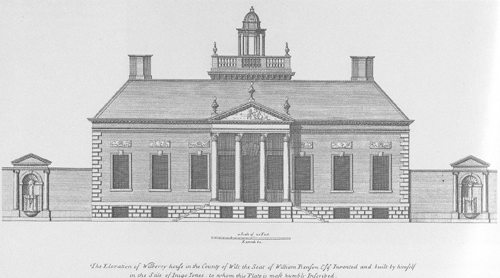
Wilbury House, Wiltshire, England, as seen in Vitruvius Britannicus, 1715. Considered one of England's greatest Palladian residences, it was skillfully restored over the last decade or so by Miranda, Countess of Iveagh, who died last month.

"... [Wilbury House] made a lasting impression on [my mother] at an age when sensitive children notice the details of their surroundings. Muv never again lived in a fine eighteenth-century house like Wilbury, her ideal, but her ability to make her succession of houses attractive and original on little money was one of her outstanding talents. She did not bow to fashion, mixing furniture and objects from different periods which many people would have thought unsuitable for their surroundings. She used what was available .... Junk shops drew her like a magnet .... She never employed a decorator or sought advice; she knew what she wanted and got it done."

So the Dowager Duchess of Devonshire wrote, about her mother, Lady Redesdale (née Sydney Bowles), in her recently published and highly entertaining autobiography, Wait for Me! Memoirs (Farrar, Straus, Giroux, 2010). As a child in the late 1880s and early 1890s, Lady Redesdale lived at Wilbury, when her father, publisher Thomas Gibson Bowles, and Wilbury's owners, Sir Henry and Lady Mallet, agreed to save on expenses by sharing the house.